


Vitamin D deficiency is the insufficiency of this fat-soluble nutrient that weakens bones, muscles, and the immune system, and is especially common in women aged 45 and over. Clinically known as hypovitaminosis D, it is detected by analyzing 25-hydroxyvitamin D (25-OH vitamin D or calcidiol) in the blood. In Spain, months of low sun exposure reduce skin synthesis for a good part of the year, making middle-aged women one of the groups with the highest risk of deficiency. Understanding this problem is the first step to acting wisely.
How is vitamin D deficiency diagnosed in women over 45?
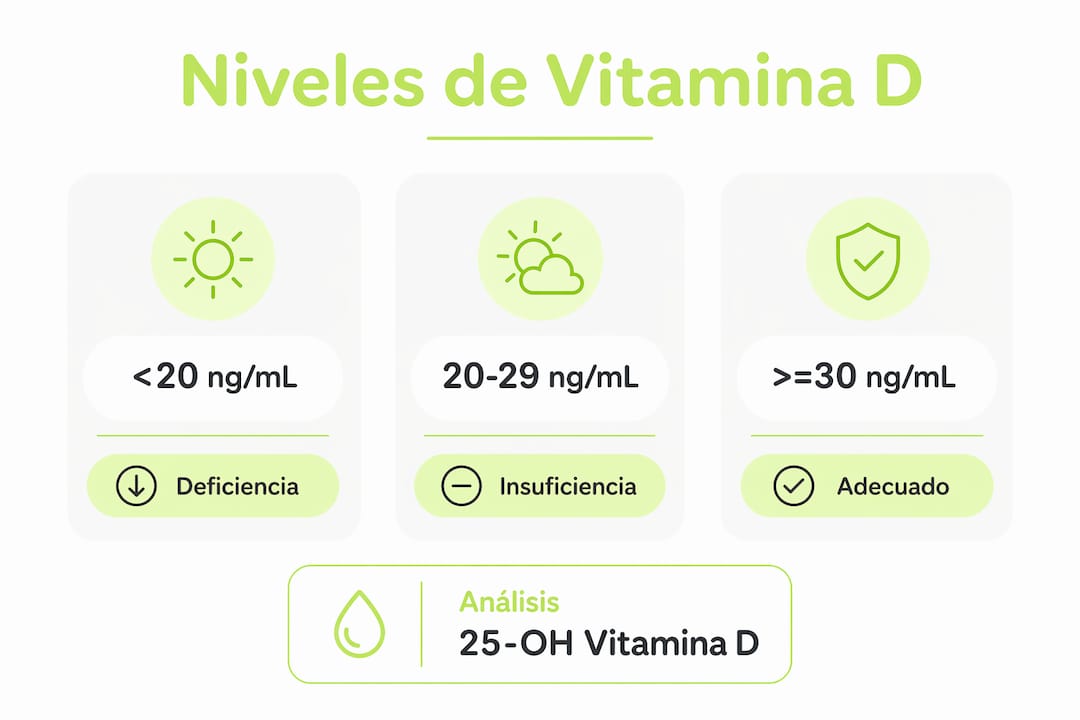
The only reliable test to detect deficiency is the measurement of 25-OH vitamin D in the blood. The most commonly used clinical reference values establish that values below 20 ng/mL indicate deficiency, while between 20 and 29 ng/mL is considered insufficiency. Above 30 ng/mL is considered adequate for most adults. This distinction matters because treatment varies depending on the baseline level.
A common mistake in clinical practice is to request 1,25-dihydroxyvitamin D instead of calcidiol. 1,25-dihydroxyvitamin D does not reflect actual vitamin D stores in the body, as it may appear normal or even elevated when there is a real deficiency. Only 25-OH vitamin D accurately shows the status of body reserves.
| Blood Level | Clinical Interpretation |
|---|---|
| Less than 20 ng/mL | Deficiency: requires treatment |
| 20 to 29 ng/mL | Insufficiency: consider supplementation |
| 30 to 100 ng/mL | Adequate levels for most |
| More than 100 ng/mL | Risk of toxicity: avoid |
In cases with suspected mineral metabolism disorders, the doctor may also request serum calcium and PTH (parathyroid hormone) to better understand the functional impact of the deficiency. These complementary analyses help personalize the approach and rule out other causes of bone or muscle weakness.
Professional advice: Always request the 25-OH vitamin D test by its exact name. If the result comes back as "vitamin D" without specifying the fraction measured, ask your doctor which test was performed exactly.
Symptoms of vitamin D deficiency that you shouldn't ignore
Persistent fatigue and muscle weakness are the most frequent symptoms of hypovitaminosis D. However, the deficiency may not show clear symptoms, causing many women to attribute their discomfort to stress, menopause, or their lifestyle. This absence of obvious signs makes laboratory testing the only reliable diagnostic tool.
The most common signs that may indicate a deficiency include:
- Unexplained tiredness, even after adequate rest
- Diffuse bone pain, especially in the lower back, hips, and legs
- Muscle weakness that makes everyday activities like climbing stairs difficult
- Mood changes, including irritability or persistent sadness
- Increased frequency of infections, such as colds or respiratory processes
- Difficulty concentrating or feeling mental fog
The problem is that all these symptoms are non-specific. Fatigue can be due to anemia, hypothyroidism, or insomnia. Muscle pain can be related to a sedentary lifestyle or fibromyalgia. Therefore, relying only on physical signs can delay an accurate diagnosis. Blood tests are essential to confirm or rule out a deficiency.
Professional advice: If you experience two or more of these symptoms continuously for more than four weeks, ask your general practitioner for a complete blood test that includes 25-OH vitamin D, a complete blood count, and thyroid function.
Why are women over 45 at higher risk of deficiency?
Several biological and environmental factors combine to reduce vitamin D levels in women over 45. Understanding each helps make more informed decisions about sun exposure, diet, and supplementation.
-
Reduced skin synthesis with age. The skin produces less vitamin D with the same sun exposure as we age. At 45, the capacity for skin synthesis is significantly lower than at 25, meaning that the same amount of time in the sun generates less active vitamin D.
-
Months of low sun exposure in Spain. Skin synthesis decreases for several months a year in Spain, especially between October and March. In northern cities like Bilbao or Santiago de Compostela, this period can extend up to eight months. This creates an accumulated deficit that is not automatically corrected with the arrival of summer.
-
The myth of spring sun. Many women assume that with good weather, levels recover on their own. However, vitamin D production is not instantly restored with the spring sun. The accumulated deficit during winter requires weeks of adequate exposure to correct, and in many cases, it is not corrected without supplementation.
-
Higher proportion of adipose tissue. Vitamin D is fat-soluble, which means that adipose tissue retains it and reduces its availability in circulation. In overweight women or those with a body fat redistribution typical of middle age, adipose tissue increases vitamin D retention, leaving less active vitamin D in the blood.
-
Hormonal changes in perimenopause. The drop in estrogen alters calcium and vitamin D metabolism. This increases the rate of bone loss and reduces the efficiency with which the body uses available vitamin D, creating a greater demand at a time when synthesis is already compromised.
When and how to supplement vitamin D in women over 45
Vitamin D supplementation is not a decision that should be made without prior analysis. Systematic supplementation is not recommended for healthy postmenopausal women without demonstrated deficiency or increased risk. This recommendation from leading scientific societies is based on real evidence: supplementing unnecessarily does not provide benefits and can carry risks.
The relationship between vitamin D and calcium is fundamental to understanding why deficiency is so important for bone health. Supplementing calcium without vitamin D is insufficient to protect bones in postmenopausal women. Vitamin D acts as a facilitator of intestinal calcium absorption. Without adequate levels of calcidiol, ingested calcium, whether from diet or supplements, is not properly absorbed.

| Source of Vitamin D | Advantages | Limitations |
|---|---|---|
| Sun exposure | Free, natural, effective in summer | Insufficient in winter and for mature skin |
| Diet (oily fish, eggs, dairy) | Useful complement | Low intake, difficult to meet needs solely with diet |
| Oral supplements (D3) | Controlled and adjustable dose | Requires medical prescription and monitoring |
The treatment goal should be adjusted according to the baseline level and the clinical context of each woman. A severe deficiency (less than 12 ng/mL) requires supervised loading doses. A mild insufficiency can be corrected with more moderate maintenance doses. Fixed doses without prior evaluation are one of the most common errors, along with intermittent boluses of very high doses that create peaks without maintaining stable levels.
Professional advice: Avoid buying vitamin D supplements without knowing your baseline level. A prior blood test allows you to know exactly what dose you need and for how long, avoiding both undertreatment and toxicity from excess.
Real impact of deficiency on the health of women over 45
Hypovitaminosis D affects several body systems simultaneously, though not always visibly. Its most documented consequences in middle-aged women are:
- Bone health: Prolonged deficiency accelerates bone mineral density loss and increases the risk of osteoporosis and fractures, especially of the hip and spine.
- Muscle function: Muscle weakness associated with deficiency contributes to sarcopenia (loss of muscle mass) and increases the risk of falls, with serious consequences for women over 50.
- Immune system: Vitamin D regulates the immune response. Its deficiency is associated with increased susceptibility to respiratory infections and chronic inflammatory processes.
- Mood and cognitive function: Several studies link low vitamin D levels with a higher prevalence of depressive symptoms and mild cognitive impairment, although the causal relationship is not fully established.
However, the benefits of supplementation have clear limits. A meta-analysis of 153,902 participants showed that supplementing vitamin D or calcium separately has little clinical impact on preventing fractures and falls in the general population. This means that supplementing without a prior deficiency does not significantly protect bones. The real benefit occurs when a real deficiency is corrected, not as a universal preventive measure.
Vitamin D is not a universal insurance against osteoporosis. Its real value lies in correcting a demonstrated deficiency, not in supplementing as a precaution without prior analysis.
Our vision on managing vitamin D deficiency in women over 45
At Tres60, we work with women who come with diffuse symptoms: fatigue, muscle pain, mood swings. Many have already tried various supplements on their own without noticing improvement. The pattern frequently repeats: supplementation is done without knowing the baseline level, or a generic dose is taken that does not correspond to the actual deficiency.
What we have observed is that analytics completely change the approach. When a woman knows her exact 25-OH vitamin D level, the decision of whether to supplement, with what dose, and for how long becomes clear and personalized. Without that data, any recommendation is a guess.
We have also seen that many women confuse the symptoms of deficiency with those of perimenopause, and vice versa. Both can coexist, and treating only one without evaluating the other leaves the problem halfway. The strategy that works integrates clinical analysis, hormonal context, and supplementation adjustment according to real results, not isolated symptoms.
Personalization is not a luxury. It is the difference between taking something that helps and taking something that does not work or that, in excessive doses, can be harmful. Before buying any vitamin D supplement, get a blood test. It's the step that changes everything.
— Tres60
Support your bone and muscle health with the right formula
If your blood test confirms a vitamin D deficiency, the choice of supplement also matters. At Tres60, we have formulated a supplement with doctors that combines the three key nutrients for bone and muscle health in women aged 45 and over.

Our Vitamin D3 + K2 + Magnesium combines vitamin D3 to correct deficiency, vitamin K2 to direct calcium to bones and away from arteries, and magnesium to support muscle and nerve function. This combination responds to the real needs of middle-aged women, not a generic formula. If you want to explore more options for your general well-being, at Tres60 you will find supplements formulated with medical criteria and personalized guidance.
FAQ
What vitamin D level is considered deficiency?
Values below 20 ng/mL of 25-OH vitamin D in the blood indicate clinical deficiency. Between 20 and 29 ng/mL is considered insufficiency, and above 30 ng/mL, levels are considered adequate for most adults.
Can you have vitamin D deficiency without symptoms?
Yes. Many women with confirmed deficiency show no obvious symptoms, which makes blood tests essential for diagnosis. Relying solely on physical signs can delay treatment.
Is sun exposure enough to maintain adequate levels?
Not always. In Spain, solar radiation is insufficient to synthesize vitamin D for several months a year, and skin synthesis capacity decreases with age. Sun exposure helps, but does not guarantee optimal levels without prior analysis.
Should I take vitamin D if I am in perimenopause?
Only if an analysis confirms deficiency or insufficiency. Scientific societies do not recommend systematic supplementation without demonstrated deficiency. The dose and duration should be adjusted to the baseline level and individual clinical context.
What is the difference between vitamin D2 and D3 in supplements?
Vitamin D3 (cholecalciferol) is the form the body produces with sun exposure and the one that raises blood levels most effectively and lastingly. D2 (ergocalciferol) is plant-derived and has lower biological potency. D3 supplements are the most recommended in current clinical practice.
Key Points
Vitamin D deficiency in women aged 45 requires accurate analytical diagnosis, as symptoms are non-specific and supplementation without confirmed deficiency does not provide clinically relevant benefits.
| Point | Details |
|---|---|
| Accurate diagnosis | Always measure 25-OH vitamin D in blood; values below 20 ng/mL confirm deficiency. |
| Non-specific symptoms | Fatigue, bone pain, and mood changes may indicate deficiency, but require blood tests for confirmation. |
| Risk factors in women over 45 | Age, winter in Spain, and hormonal changes reduce vitamin D synthesis and availability. |
| Personalized supplementation | Dose should be adjusted to baseline level; supplementing without demonstrated deficiency does not prevent fractures or falls. |
| Vitamin D and calcium together | Vitamin D is necessary to absorb calcium; taking calcium without vitamin D is insufficient to protect bones. |


